
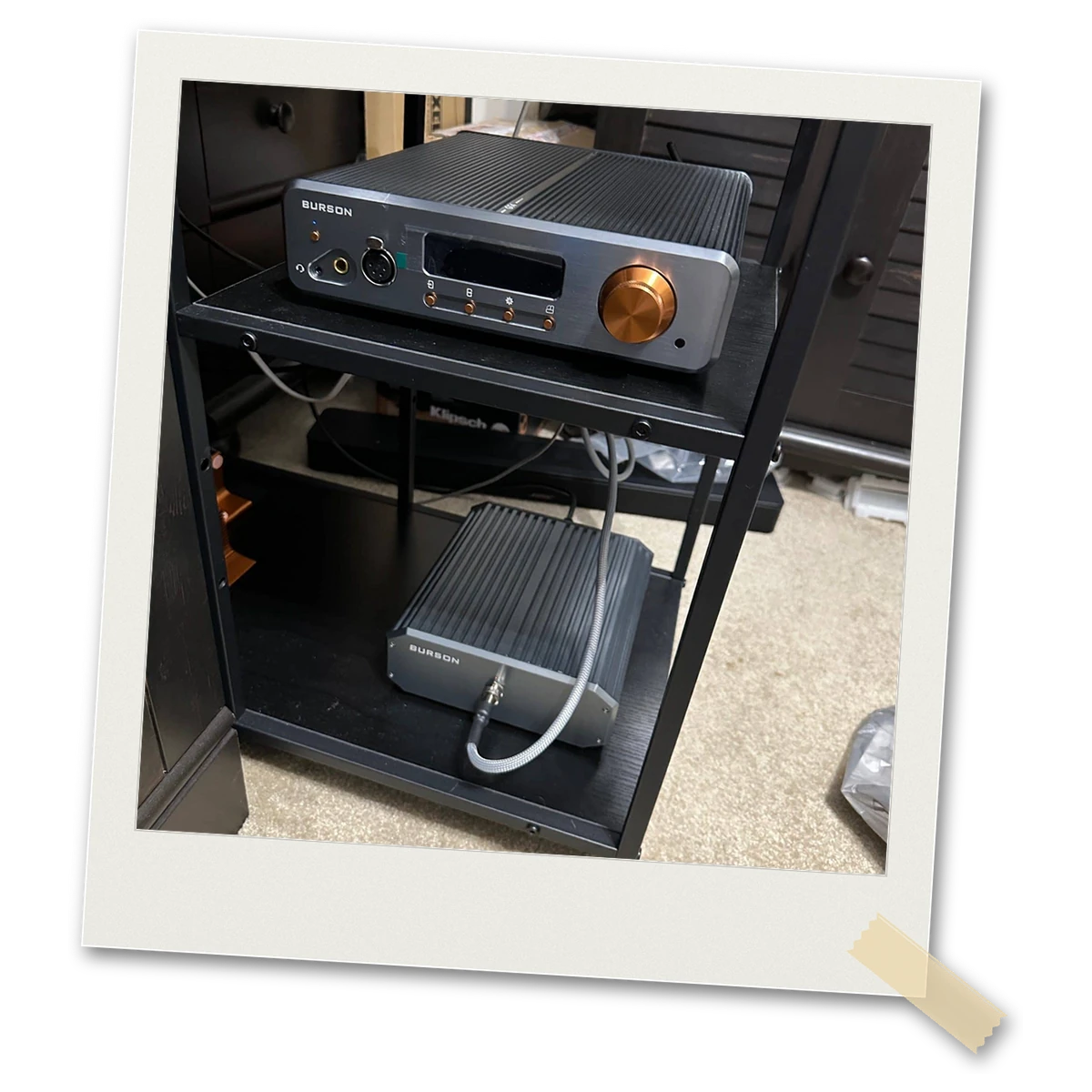
Jason Burson Conductor GT4 with Focal Utopia, Focal Radiance and Meze Empyrean

Jason’s Burson Conductor GT4 with Focal Utopia, Focal Radiance and Meze Empyrean

Published on

Post Info

My audio journey began with the Burson HA-160D when I was stationed overseas. I was immediately drawn to its signature sound, which had a warmth and depth that really appealed to me. However, as time went on, I started yearning for something more—something that offered greater convenience, more power, and the latest in cutting-edge technology. The Conductor series had been on my radar for a while, but when the Fusion Core was announced alongside the GT4, I knew I couldn’t wait any longer. The combination of sleek design, enhanced performance, and innovative features was exactly what I had been looking for, so I finally decided to pull the trigger.

The System

Listening with

Focal Utopia · Headphones: open-back, dynamic (40 mm beryllium M-dome), circumaural · discontinued
  • Impedance: 80 Ω
  • Sensitivity: 104 dB SPL / 1 mW @ 1 kHz ≈ 115.0 dB/V (calc.)
  • Frequency response: 5 Hz – 50 kHz
  • Plugs / cables supplied: 6.35 mm cable and 3.5 mm cable, 4-pin XLR cable; Lemo connectors at the cups
  • Other: THD <0.2% @ 1 kHz / 100 dB SPL

Matching notes: At 80 Ω and 104 dB/mW, the Focal Utopia is a low-impedance load, and an efficient one: about 0.56 V (4 mW, 7.1 mA) for 110 dB SPL (calc.). Burson does not publish a 80 Ω rating for the Conductor GT4. Its 32 Ω and 100 Ω ratings (10 W XLR / 5 W SE; 5 W XLR / 2.5 W SE) fall either side of it. The Conductor GT4’s 0.5 Ω headphone output impedance is 1/160 of the load. [1] [2] [3] [4]

Focal Radiance · Headphones: closed-back, dynamic (40 mm Al/Mg M-shape dome), circumaural · discontinued
  • Impedance: 35 Ω
  • Sensitivity: 105 dB SPL / 1 mW @ 1 kHz ≈ 119.6 dB/V (calc.)
  • Frequency response: 5 Hz – 23 kHz
  • Plugs / cables supplied: 1.2 m OFC cable, 3.5 mm TRS plug + 6.35 mm adapter; 3.5 mm mono sockets on cups
  • Other: THD 0.1% @ 1 kHz / 100 dB SPL; 435 g

Matching notes: At 35 Ω and 105 dB/mW, the Focal Radiance is a low-impedance load, and an efficient one: about 0.33 V (3.2 mW, 9.5 mA) for 110 dB SPL (calc.). Burson does not publish a 35 Ω rating for the Conductor GT4. Its 32 Ω and 100 Ω ratings (10 W XLR / 5 W SE; 5 W XLR / 2.5 W SE) fall either side of it. The Conductor GT4’s 0.5 Ω headphone output impedance is 1/70 of the load. [5] [6] [3] [4]

Meze Empyrean · Headphones: open-back, isodynamic hybrid array (planar), circumaural · discontinued
  • Impedance: 31.6 Ω
  • Sensitivity: 100 dB SPL (1 mW / 1 kHz) ≈ 115.0 dB/V (calc.)
  • Frequency response: 4 Hz – 110 kHz
  • Plugs / cables supplied: 4-pin mini-XLR cable; 3 m OFC XLR cable
  • Other: max SPL >130 dB; THD <0.1%; ~430 g; Rinaro driver

Matching notes: At 31.6 Ω and 100 dB/mW, the Meze Empyrean is a low-impedance load, and an efficient one: about 0.56 V (10 mW, 18 mA) for 110 dB SPL (calc.). Burson does not publish a 31.6 Ω rating for the Conductor GT4; its nearest published rating is 10 W XLR / 5 W SE into 32 Ω. The Conductor GT4’s 0.5 Ω headphone output impedance is 1/63 of the load. [7] [3] [4]

Kennerton Rognir Planar
Kennerton Gjallarhorn GH50 JM Edition
OPPO PM-1 · Headphones: open-back, planar magnetic (85 x 69 mm oval, push-pull neodymium), circumaural · discontinued
  • Impedance: 32 Ω
  • Sensitivity: 102 dB (1 mW) ≈ 116.9 dB/V (calc.)
  • Frequency response: 10 Hz – 50 kHz (free field)
  • Plugs / cables supplied: detachable: 3 m OCC cable (6.35 mm), 1 m OFC cable (3.5 mm); 2.5 mm mono jacks at cups
  • Other: long-term max input 500 mW (IEC 60268-7), pulse 2 W; 395 g without cable; clamping 5 N

Matching notes: At 32 Ω and 102 dB/mW, the OPPO PM-1 is a low-impedance load, and an efficient one: about 0.45 V (6.3 mW, 14 mA) for 110 dB SPL (calc.). Burson rates the Conductor GT4 at 10 W (XLR) / 5 W (SE) into 32 Ω, which is about 17.9 V / 12.6 V RMS (calc.), roughly 32 dB / 29 dB more than that. The Conductor GT4’s 0.5 Ω headphone output impedance is 1/64 of the load. [8] [3] [4]

Burson Composer

Burson

Burson Conductor GT4 · DAC / headphone amplifier / preamp
  • Output power (XLR / SE): 32 Ω 10 W / 5 W · 100 Ω 5 W / 2.5 W · 150 Ω 3 W / 1.5 W · 300 Ω 2 W / 1 W
  • Output impedance: 0.5 Ω (headphone); 1 Ω (pre out); 25 Ω (DAC out)
  • Output voltage: RCA 2 V (DAC out) · XLR 4 V (DAC out); pre out max 12 V RMS
  • Gain: 2 levels: High full power (XLR 10 W / SE 5 W), Low 10% (IEM); dB not published
  • Inputs: 2x XLR; 2x RCA; USB (XMOS; PCM to 768 kHz/32-bit, native DSD512); Toslink; coaxial (24/192); Bluetooth 5.0 aptX HD; microphone
  • Input impedance: 40 kΩ
  • Input sensitivity: line level (24-bit/192 kHz ADC on analogue inputs)
  • Outputs: headphone 6.35 mm / 4-pin XLR / 3.5 mm; XLR + RCA pre out; subwoofer pre out; XLR + RCA line (DAC) out
  • DAC / chipset: 2x ESS9038 (one chip per channel; suffix not published)
  • Other: THD <0.0015%; FR ±1 dB 0-58 kHz; versions: Standard (V6 Vivid, SP01, 24V5A) / Deluxe (V7 Vivid, SP02, Super Charger 5A) / Max (+Fusion Core 24V)

[3] [4]

Also in the system

Behringer Truth

Specs from manufacturer data unless a source below says otherwise. “calc.” values are worked out from those figures (V = √(P × R); 110 dB SPL used as a loud reference level). Gear listed without specs is not in our spec library yet.

  1. Focal Utopia: PDF (dam.focal-naim.com)
  2. Focal Utopia: focalnaimaudio.com
  3. Burson Conductor GT4 product page
  4. Burson Conductor GT4 User Manual V1.2 (Burson downloads)
  5. Focal Radiance: PDF (dam.focal-naim.com)
  6. Focal Radiance: focal.com
  7. Meze Empyrean: archived page (web.archive.org)
  8. OPPO PM-1: oppodigital.com