
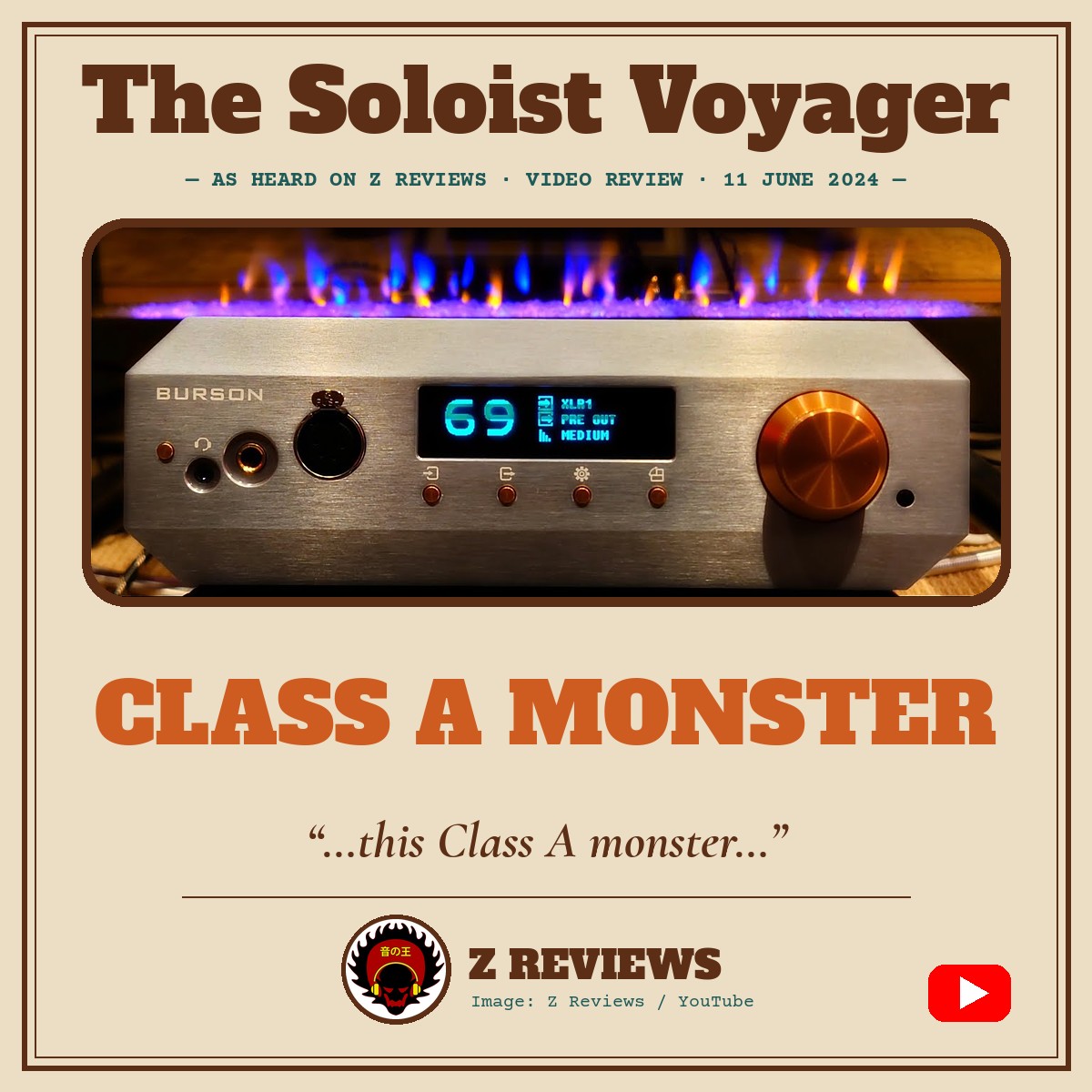
Z Reviews has covered the Burson Soloist Voyager, Burson’s top-of-the-line headphone amplifier and preamp, in a detailed video (11 June 2024) on a unit loaned by Bloom Audio. In his usual blunt style he tours the connections, buttons and settings menu, then explains how it sounds and what he would like Burson to change.
He describes it as a pure Class A design rated at 10 Watts per channel balanced, marketed as both a headphone amplifier and a Class A preamp. His unit came with the upgraded power supply, and he points out that Burson encourages owners to open it and swap the discrete op-amps.
The front has a 3.5 mm four-pole headset pass-through, with a matching microphone output on the back, plus a 6.3 mm output and a four-pin XLR balanced output. Four buttons sit under the display, with a large volume knob. Outputs can be set to headphones, pre-out, or headphones plus a subwoofer output. The rear has two XLR and two RCA inputs, XLR and RCA pre-outs, the subwoofer RCA, and 12V trigger connections. The all-metal remote handles mute, input and volume.
The menu covers high, medium and low gain, left/right balance, display brightness, remote on/off, reset and auto-off. He highlights the built-in crossfeed with three levels, noting that an analog crossfeed is rare and can make headphone listening sound more natural and focused. On low gain he had no noise-floor concerns, even with sensitive IEMs.
The Voyager is passively cooled through large heatsinks, with no fan. He measured around 42°C on the case and about 50°C at the rear vents, and recommends never covering it.
He hears it as warmer, bigger and fuller. It drove his hardest-to-power headphones cleanly and linearly, and as a preamp it made the Topping amplifiers he used sound bigger, warmer and fuller. His highest praise is that it sounds distinct: “at least it sounds different than everything” else. For that reason he says he would not use it as his reference amp for reviewing headphones.
He sums it up as a big, simple, powerful Class A amp that Burson should be proud of. For anyone wanting a warmer, fuller sound with plenty of power, he says to drop it into the system, give it room to breathe and enjoy.
Watch the full video on Z Reviews’s YouTube channel: Burson Soloist Voyager.
Discover the full features and specifications on the Burson Soloist Voyager product page.
We noticed you're visiting from Australia. We've updated our prices to Australian dollar for your shopping convenience. Use United States (US) dollar instead. Dismiss