
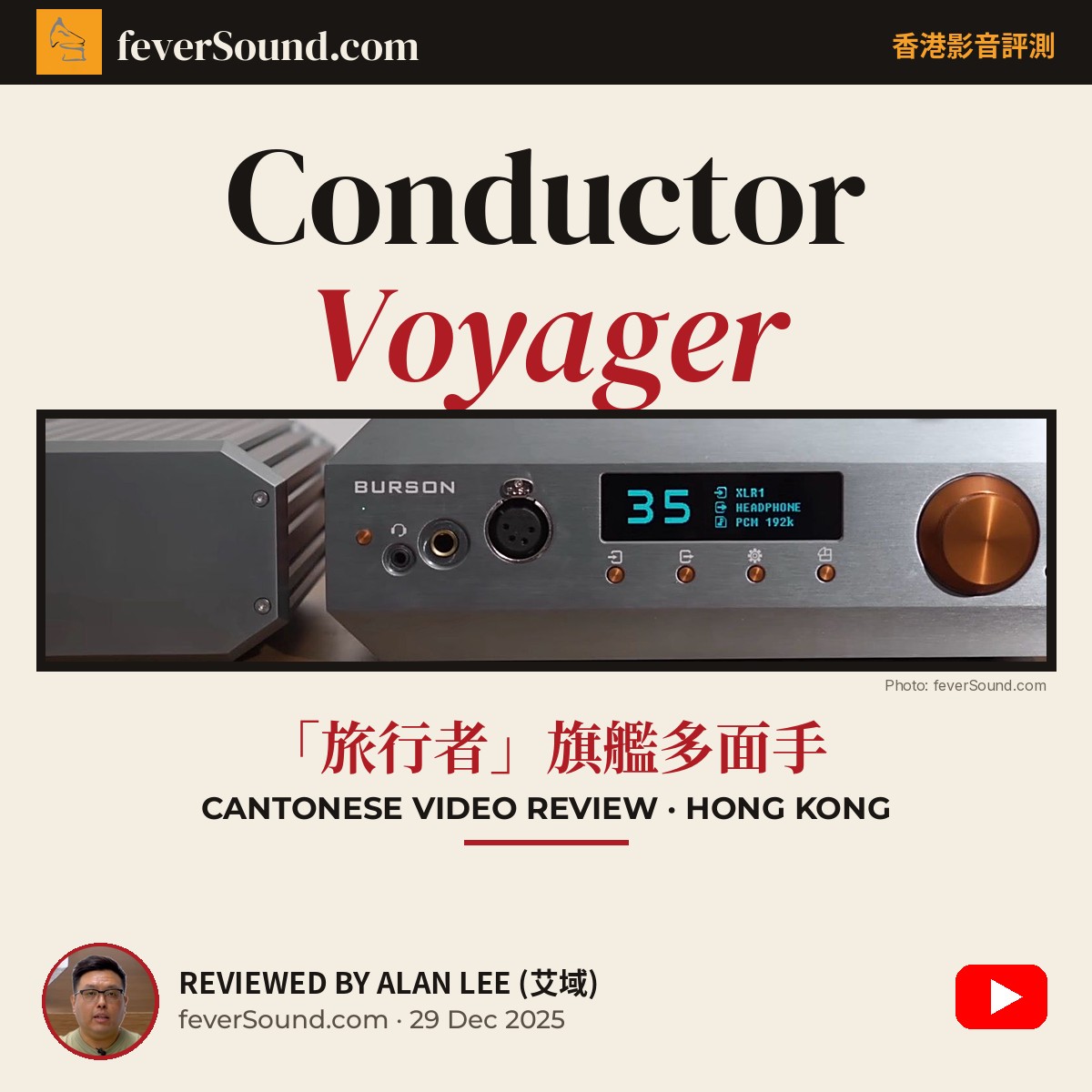
Hong Kong audio channel feverSound has published a Chinese-language (Cantonese) video review of the Burson Conductor Voyager. Reviewer Alan Lee (艾域) titled it 「旅行者」旗艦多面手, which means “the Voyager, a flagship all-rounder”. The video premiered on 29 December 2025. Below is our English summary of what he says. It is translated from Cantonese, so the wording is ours. Please watch the video for his exact comments.
Alan notes that the Conductor Voyager was launched at the AV show in August. It combines a DAC, a preamp and a headphone amplifier. It uses the ESS ES9039PRO DAC chip, and the USB-C input handles PCM up to 32bit/768kHz and DSD512. Bluetooth 5.0 uses a Qualcomm CSR8675 chip with LDAC and aptX HD support.
He walks through the design. The I/V conversion and low-pass filter stage are fully discrete. The layout is dual mono, with V7 discrete op-amps and seven Silent Power Modules. The headphone stage is pure Class A, with four Onsemi MJE15032 transistors per channel and a Max Current power supply. Burson rates it at 10W balanced and 5W single-ended into 16Ω. There is also a headphone-plus-subwoofer mode.
The menu offers DPLL, FIR filter (six roll-off options), THD compensation, IIR bandwidth and DAC path settings. The front panel has 6.35mm, 3.5mm and 4-pin XLR headphone outputs. The rear panel has two RCA and two XLR analogue inputs, plus optical, coaxial, USB-C and Bluetooth inputs. Outputs are RCA, XLR and subwoofer, with two 12V trigger outputs, one 12V trigger input and a 24V 5A power inlet. In the box are a metal remote, spare op-amps, screws and a hex key, XLR-to-RCA adapters and a 3.5mm cable.
Alan tested the MAX package with the Fusion Core 24V 15A GaN power supply. His headphones were the original Campfire Audio Andromeda IEM, Sennheiser HD 800 S, Audeze LCD-XC Carbon and Audeze LCD-S20. He notes that Burson also uses Audeze headphones as a development reference.
Compared with the Supercharger supply, he found the Fusion Core gives a blacker, quieter background and more transparency. In his view the MAX upgrade is not essential, but it does help.
Watch the full review (in Cantonese) on feverSound’s YouTube channel, or read the listing on feverSound.com.
Discover the full features and specifications on the Burson Conductor Voyager product page.
We noticed you're visiting from Australia. We've updated our prices to Australian dollar for your shopping convenience. Use United States (US) dollar instead. Dismiss