
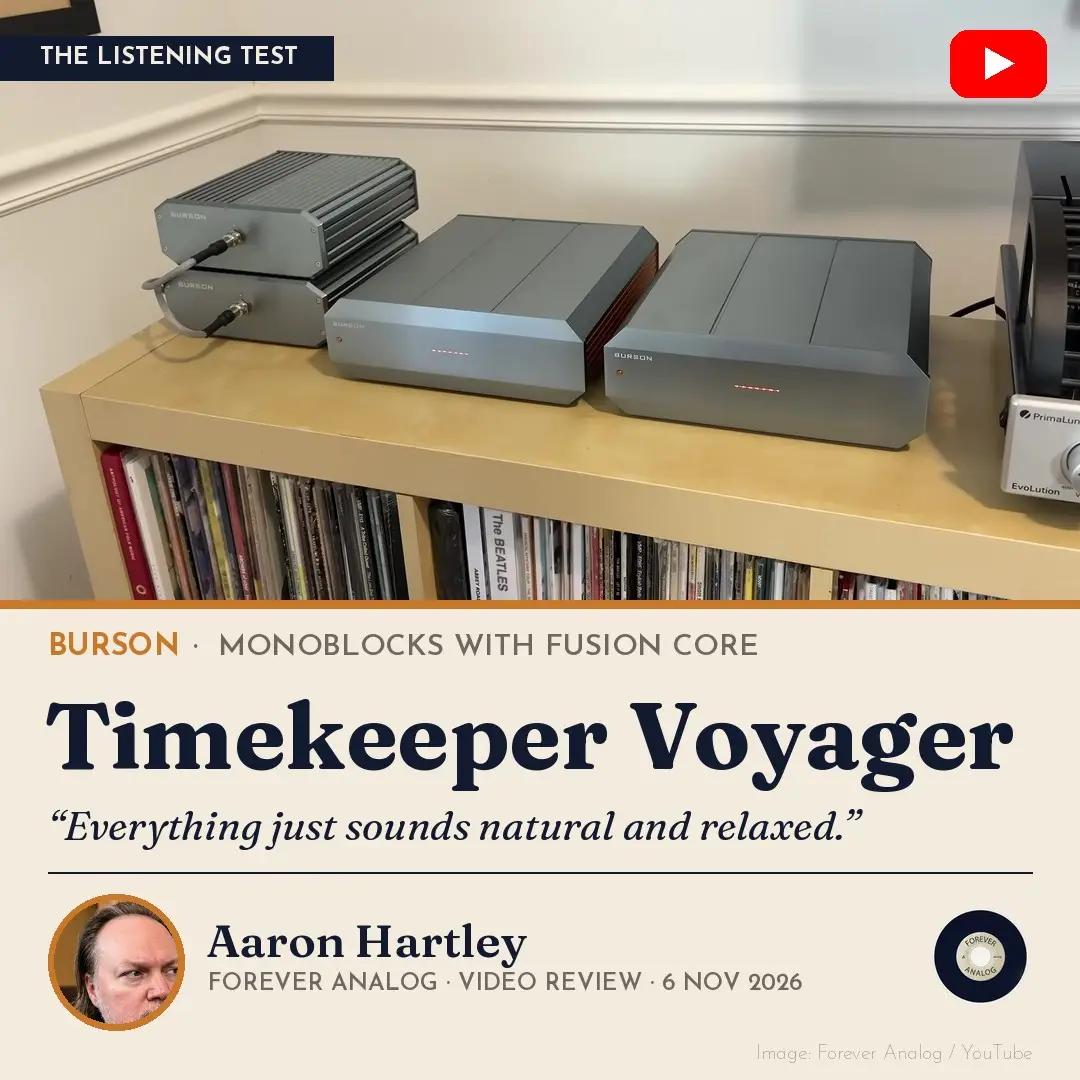
Aaron Hartley of Forever Analog has spent several weeks with the Burson Timekeeper Voyager monoblock amplifiers and their Fusion Core power supplies, and shares the whole journey in a video review on YouTube. Once his system was dialled in, his verdict was simple: “if I had to pick one word to describe the overall listening experience, it would be effortless. Everything just sounds natural and relaxed.”
Rather than an instant “end game” story, Aaron takes viewers through every step it took to get the best from the amps in his own room: what worked, what didn’t, and what he learned about his whole system along the way. As he puts it, there is “something important these amps can teach us about getting the best sound from our stereo system regardless of our budget.”
Beyond what he calls their “very Star Treky design”, he highlights the features that set the Timekeeper Voyagers apart:
He notes the amps run warm in class A, while the power supplies “never feel warm to the touch”, and the amps power themselves off when left idle long enough.
His first step was simply swapping the Timekeeper Voyagers in for his vintage McIntosh tube amplifier and leaving everything else the same, including his vintage Dynaco PAS 3 tube preamp and ADS L620 speakers. He was honest that this first pairing did not click: “Something just wasn’t quite right.” Looking back he explains: “With the Dynaco, I thought the midrange was a little too forward, bass was lacking, and the overall sound was missing some of the body and fullness I was accustomed to hearing. It just sounded thin.”
Switching to his FiiO K17 R2R preamp improved things, which taught him a lesson worth sharing: “Just because you introduce one new expensive component into your stereo system, doesn’t mean you’re automatically going to get better sound.”
Then came his PrimaLuna tube preamp, and “this combination sounded much, much better.” With it, “Vocals had more weight, instruments seemed to have more room to breathe”, and the PrimaLuna “seemed to just bring out some life in these Burson monoblock amplifiers more than the other preamps.”
Next he moved his JBL 4311B three-way studio monitors into the main system. With the Bursons and the PrimaLuna, “the sound really began to open up”, with more midrange presence and fullness, greater clarity in the highs and a bigger soundstage. Finally he added his Emotiva subwoofer via the PrimaLuna’s second set of outputs: “Suddenly, the system had a lot more of the low-end fullness I’ve been missing.” Through every change, “the one thing that remained constant was the Burson amplifiers.”
Listening to familiar music on vinyl and CD, he found that “Nothing feels strained or like the amps are working particularly hard even when the music gets more demanding.” Highlights from his listening:
With his high-efficiency speakers, he says the amps are “barely working at all”, and admits they have him tempted to try a pair of harder-to-drive speakers.
Once everything was dialled in, he spent an entire weekend going through his record and CD collection: “Everything sounded easy, great, effortless. It was just so much fun.” His wider takeaway is one we fully agree with: experiment with the equipment you already own, because the right preamp, speakers and setup make all the difference.
Thank you, Aaron, for such an honest and detailed look at the Timekeeper Voyager.
Discover the full features and specifications on the Burson Timekeeper Voyager product page.
We noticed you're visiting from Australia. We've updated our prices to Australian dollar for your shopping convenience. Use United States (US) dollar instead. Dismiss