
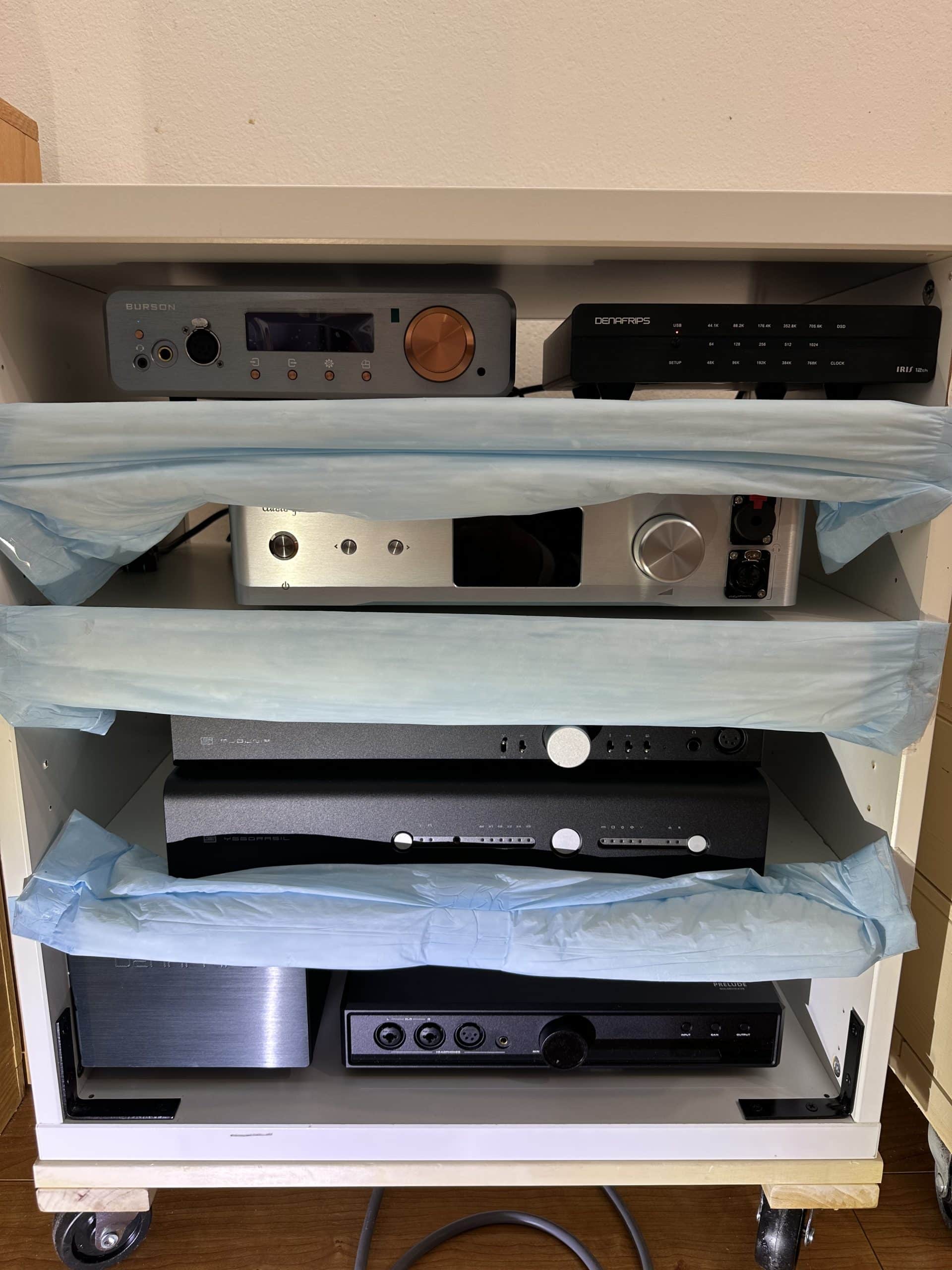
I’ve spent about 5 hours with the Soloist 3X GT so far, and I must say, I’m thoroughly impressed by the sound. In brief, the resolution and the expansive soundstage are truly exceptional—among the best I’ve experienced. This is my very first Burson product, and I couldn’t be more pleased with the performance. I was fortunate enough to receive a 50% discount on an ex-demo unit, bringing the price down to $1249, which made it even more of a great value.
If I can secure the same 50% off discount on an ex-demo unit for the Voyager, I’ll definitely be purchasing that as well. For anyone reading this, take note—if you get the chance to grab a great deal on a Burson product, don’t hesitate!
The System
Listening with
- Impedance: 14 Ω
- Sensitivity: 90 dB/1mW (at Drum Reference Point) ≈ 108.5 dB/V (calc.)
- Frequency response: 5 Hz – 50 kHz
- Plugs / cables supplied: 2.5 m braided 4-pin XLR balanced cable; 4-pin XLR to 6.35 mm adapter; 6.35 to 3.5 mm adapter
- Other: recommended power >500 mW (min >100 mW; max 5 W RMS);
Matching notes: At 14 Ω and 90 dB/mW, the LCD-5 is a low-impedance load, and a fairly demanding one: about 1.2 V (100 mW, 85 mA) for 110 dB SPL (calc.). Burson does not publish a 14 Ω rating for the Soloist GT4; its nearest published rating is 10 W XLR / 5 W SE into 32 Ω. The Soloist GT4’s 0.5 Ω headphone output impedance is 1/28 of the load. [1] [2] [3]
- Impedance: 35 Ω
- Sensitivity: 96 dB (reference not stated by HiFiMAN)
- Frequency response: 8 Hz – 65 kHz
- Plugs / cables supplied: not published (HiFiMAN spec page lists no connector)
- Other: weight 440 g
- Impedance: 55 Ω
- Sensitivity: 104 dB SPL / 1 mW @ 1 kHz ≈ 116.6 dB/V (calc.)
- Frequency response: 5 Hz – 28 kHz
- Plugs / cables supplied: 4-pin XLR; 6.35 mm; 3.5 mm cables supplied
Matching notes: At 55 Ω and 104 dB/mW, the Focal Clear is a low-impedance load, and an efficient one: about 0.47 V (4 mW, 8.5 mA) for 110 dB SPL (calc.). Burson does not publish a 55 Ω rating for the Soloist GT4. Its 32 Ω and 100 Ω ratings (10 W XLR / 5 W SE; 8 W XLR / 4 W SE) fall either side of it. The Soloist GT4’s 0.5 Ω headphone output impedance is 1/110 of the load. [5] [6] [7] [2] [3]
Burson
- Output power (XLR / SE): 32 Ω 10 W / 5 W · 100 Ω 8 W / 4 W · 150 Ω 3.8 W / 1.9 W · 300 Ω 1.3 W / 0.65 W
- Output impedance: 0.5 Ω (headphone); 25 Ω (pre out)
- Gain: 3 levels: High full power, Medium 50%, Low 10% (IEM); dB not published
- Inputs: 2x XLR; 2x RCA
- Input impedance: 38 kΩ
- Input sensitivity: RCA 2 V; XLR 4 V+ (line level)
- Outputs: XLR + SE headphone; XLR + RCA pre out; RCA subwoofer out
- Other: THD <0.0015%; FR ±1 dB 0-48 kHz; versions: Standard / Deluxe (V7 Vivid opamps, SP02, Super Charger 5A) / Max
Also in the system
- Frequency response: 20 Hz – 20 kHz (±0.1 dB); 0.5 Hz – 200 kHz (-1 dB)
- Output impedance: 75 Ω
- Output voltage: RCA 2.0 V · XLR 4.0 V
- Inputs: AES/EBU; coaxial; optical; BNC; USB (all up to 24/192)
- Outputs: 1x XLR pair; 2x RCA pairs
- DAC / chipset: 4x Analog Devices AD5791BRUZ (balanced); ADI SHARC DSP; AKM AK4113 S/PDIF; C-Media CM6632 USB
- Other: THD 0.006%; IMD 0.007% CCIF; S/N >117 dB ref 2 V; 35 W; 11.4 kg
Matching notes: Burson lists the Soloist GT4’s analogue inputs as RCA 2 V; XLR 4 V+ (line level) (38 kΩ input impedance). The Schiit Yggdrasil is rated at 2.0 V (RCA) / 4.0 V (XLR) output. [8] [9] [2] [3]
Specs from manufacturer data unless a source below says otherwise. “calc.” values are worked out from those figures (V = √(P × R); 110 dB SPL used as a loud reference level). Gear listed without specs is not in our spec library yet.
- Audeze LCD-5: audeze.com
- Burson Soloist GT4 product page
- Burson Soloist GT4 User Manual V1 (Burson downloads)
- HiFiMAN HE1000se: hifiman.com
- Focal Clear: PDF (dam.focal-naim.com) (FP_Clear_GB-pdf page)
- Focal Clear: PDF (dam.focal-naim.com) (UserManual_Clear_85x220_Web-pdf page)
- Focal Clear: focal.com
- Schiit Yggdrasil: stereophile.com (magazine reproduction of manufacturer specs)
- Schiit Yggdrasil: PDF (schiit.com) (magazine reproduction of manufacturer specs)
