
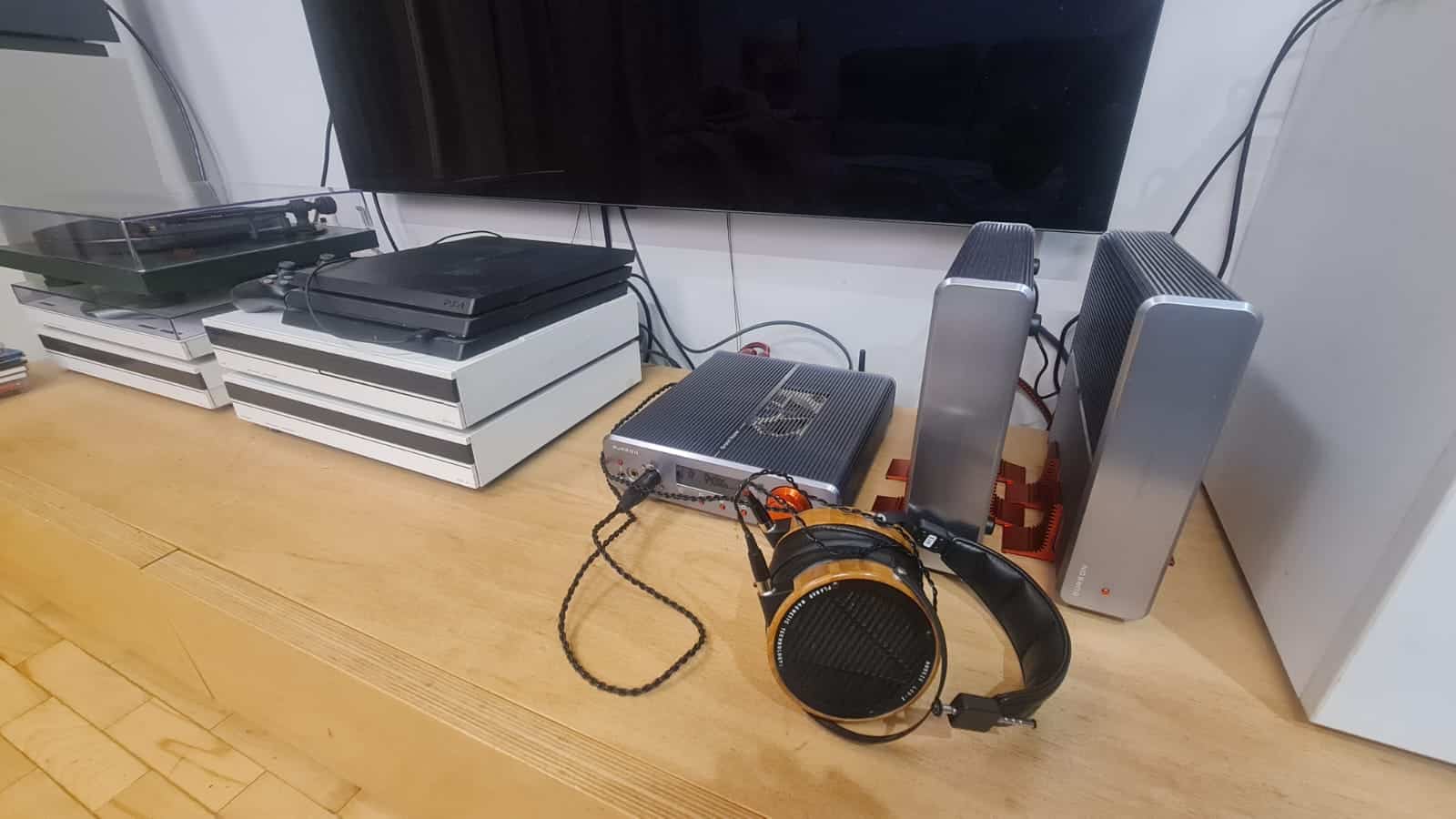
Calin’s Burson Conductor GT4 with Dynaudio Focus 160 and Audeze LCD-2 Fazor

Published on

Post Info

I’m extremely impressed with the Burson products—they’ve truly exceeded my expectations. Not only do they deliver exceptional sound quality, with rich depth and clarity, but they also boast a stunning aesthetic that adds a touch of sophistication to any setup. It’s clear that Burson puts a lot of thought into both performance and design, making them a joy to own and use.

The System

Listening with

Dynaudio Focus 160
Audeze LCD-2 · Headphones: open-back, planar magnetic, circumaural
  • Impedance: 70 Ω
  • Sensitivity: 101 dB/1mW (at Drum Reference Point) ≈ 112.5 dB/V (calc.)
  • Frequency response: 10 Hz – 50 kHz
  • Plugs / cables supplied: 4-pin XLR cable; 4-pin XLR to 6.35 mm adapter cable; 6.35 to 3.5 mm adapter
  • Other: recommended power >250 mW;

Matching notes: At 70 Ω and 101 dB/mW, the LCD-2 is a low-impedance load, and an efficient one: about 0.75 V (7.9 mW, 11 mA) for 110 dB SPL (calc.). Burson does not publish a 70 Ω rating for the Conductor GT4. Its 32 Ω and 100 Ω ratings (10 W XLR / 5 W SE; 5 W XLR / 2.5 W SE) fall either side of it. The Conductor GT4’s 0.5 Ω headphone output impedance is 1/140 of the load. [1] [2] [3]

Burson

Burson Conductor GT4 · DAC / headphone amplifier / preamp
  • Output power (XLR / SE): 32 Ω 10 W / 5 W · 100 Ω 5 W / 2.5 W · 150 Ω 3 W / 1.5 W · 300 Ω 2 W / 1 W
  • Output impedance: 0.5 Ω (headphone); 1 Ω (pre out); 25 Ω (DAC out)
  • Output voltage: RCA 2 V (DAC out) · XLR 4 V (DAC out); pre out max 12 V RMS
  • Gain: 2 levels: High full power (XLR 10 W / SE 5 W), Low 10% (IEM); dB not published
  • Inputs: 2x XLR; 2x RCA; USB (XMOS; PCM to 768 kHz/32-bit, native DSD512); Toslink; coaxial (24/192); Bluetooth 5.0 aptX HD; microphone
  • Input impedance: 40 kΩ
  • Input sensitivity: line level (24-bit/192 kHz ADC on analogue inputs)
  • Outputs: headphone 6.35 mm / 4-pin XLR / 3.5 mm; XLR + RCA pre out; subwoofer pre out; XLR + RCA line (DAC) out
  • DAC / chipset: 2x ESS9038 (one chip per channel; suffix not published)
  • Other: THD <0.0015%; FR ±1 dB 0-58 kHz; versions: Standard (V6 Vivid, SP01, 24V5A) / Deluxe (V7 Vivid, SP02, Super Charger 5A) / Max (+Fusion Core 24V)

[2] [3]

Burson Timekeeper 3X GT · Power amplifier (monoblock / stereo) · discontinued
  • Power: 8 Ω: 110 (high gain); 30 (low gain) · 4 Ω: 180 (high gain); 55 (low gain)
  • Output impedance: <0.015 Ω (20 Hz-20 kHz)
  • Gain: 29 dB; 2 gain levels (high / low)
  • Inputs: 1x RCA; 1x XLR
  • Input impedance: 100 kΩ (SE); 200 kΩ (balanced)
  • Outputs: speaker binding posts
  • Other: Model R300 (“GT3”); max power 210 W; THD <0.03% @ 1 kHz; S/N 108 dB; Super Charger 32V/6.5A

[4] [3]

Also in the system

FiiO X5iii
Pro-Ject Debut Carbon

Specs from manufacturer data unless a source below says otherwise. “calc.” values are worked out from those figures (V = √(P × R); 110 dB SPL used as a loud reference level). Gear listed without specs is not in our spec library yet.

  1. Audeze LCD-2: audeze.com
  2. Burson Conductor GT4 product page
  3. Burson Conductor GT4 User Manual V1.2 (Burson downloads)
  4. Burson Timekeeper 3X GT product page