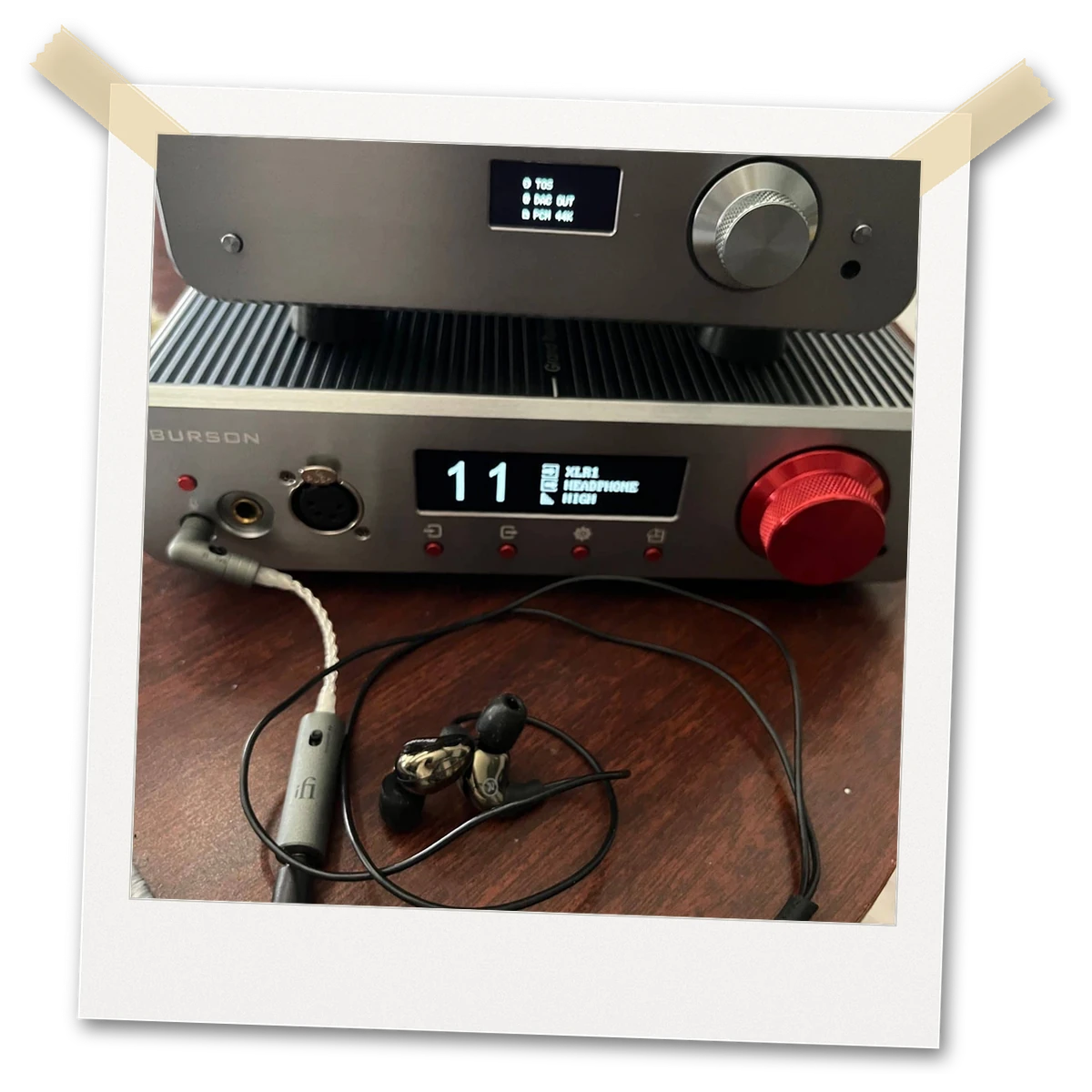
The System
Listening with
Focal Elegia · Headphones: closed-back, dynamic (40 mm Al/Mg M-dome), circumaural · discontinued
- Impedance: 35 Ω
- Sensitivity: 105 dB SPL / 1 mW @ 1 kHz ≈ 119.6 dB/V (calc.)
- Frequency response: 5 Hz – 23 kHz
- Plugs / cables supplied: 3.5 mm cable (1.2 m) (per datasheet)
Matching notes: At 35 Ω and 105 dB/mW, the Focal Elegia is a low-impedance load, and an efficient one: about 0.33 V (3.2 mW, 9.5 mA) for 110 dB SPL (calc.). Burson does not publish a 35 Ω rating for the Soloist 3X GT. Its 32 Ω and 100 Ω ratings (8 W XLR / 4 W SE; 3.8 W XLR / 1.9 W SE) fall either side of it. The Soloist 3X GT’s 0.5 Ω headphone output impedance is 1/70 of the load. [1] [2] [3] [4]
Focal Elex · Headphones: open-back, dynamic (40 mm Al/Mg M-shape dome), circumaural · discontinued
- Impedance: 80 Ω
- Sensitivity: 104 dB SPL / 1 mW @ 1 kHz ≈ 115.0 dB/V (calc.)
- Frequency response: 5 Hz – 23 kHz
- Plugs / cables supplied: two 1.8 m cables: 6.35 mm and 4-pin XLR (Neutrik)
- Other: THD <0.3% @ 1 kHz / 100 dB SPL; 450 g
Matching notes: At 80 Ω and 104 dB/mW, the Focal Elex is a low-impedance load, and an efficient one: about 0.56 V (4 mW, 7.1 mA) for 110 dB SPL (calc.). Burson does not publish a 80 Ω rating for the Soloist 3X GT. Its 32 Ω and 100 Ω ratings (8 W XLR / 4 W SE; 3.8 W XLR / 1.9 W SE) fall either side of it. The Soloist 3X GT’s 0.5 Ω headphone output impedance is 1/160 of the load. [5] [6] [7] [3] [4]
Sennheiser HD 6XX · Headphones: open-back, dynamic, circumaural
- Impedance: 300 Ω
- Sensitivity: 103 dB SPL @ 1 kHz, 1 V (as published) ≈ 97.8 dB/mW (calc.)
- Frequency response: 10 Hz – 41 kHz
- Plugs / cables supplied: 3.5 mm stereo jack plug (6.35 mm adapter); 1.8 m cable
- Other: THD <0.1% (1 kHz, 1 V)
Matching notes: At 300 Ω and 103 dB/V, the HD 6XX is a high-impedance load that needs voltage more than current: about 2.2 V (17 mW, 7.5 mA) for 110 dB SPL (calc.). Burson rates the Soloist 3X GT at 1.3 W (XLR) / 0.65 W (SE) into 300 Ω, which is about 19.7 V / 14.0 V RMS (calc.), roughly 19 dB / 16 dB more than that. The Soloist 3X GT’s 0.5 Ω headphone output impedance is 1/600 of the load. [8] [9] [3] [4]
HiFiMAN HE4XX · Headphones: open-back, planar magnetic, circumaural · discontinued
- Impedance: 35 Ω
- Sensitivity: 93 dB (reference not stated by HiFiMAN)
- Frequency response: 20 Hz – 35 kHz
- Plugs / cables supplied: 6.35 mm plug; 1.5 m removable cable
- Other: weight 370 g
[10]
Shure SE846 · Headphones: IEM, sound-isolating, quad balanced armature (3-way, true subwoofer)
- Impedance: 9 Ω
- Sensitivity: 114 dB SPL/mW (@ 1 kHz) ≈ 134.5 dB/V (calc.)
- Frequency response: 15 Hz – 20 kHz
- Plugs / cables supplied: detachable MMCX cable, 3.5 mm TRS plug
- Other: noise attenuation up to 37 dB; 4.3 g per earphone; interchangeable nozzle inserts
Matching notes: At 9 Ω and 114 dB/mW, the SE846 is a low-impedance load, and an efficient one: about 0.06 V (0.4 mW, 6.7 mA) for 110 dB SPL (calc.). Burson does not publish a 9 Ω rating for the Soloist 3X GT; its nearest published rating is 10 W XLR / 5 W SE into 16 Ω. The Soloist 3X GT’s 0.5 Ω headphone output impedance is 1/18 of the load. [11] [12] [3] [4]
Burson
- Output power (XLR / SE): 16 Ω 10 W / 5 W · 32 Ω 8 W / 4 W · 100 Ω 3.8 W / 1.9 W · 300 Ω 1.3 W / 0.65 W · 600 Ω 0.64 W / 0.32 W
- Output impedance: 0.5 Ω (headphone); 25 Ω (pre out)
- Gain: High / Medium / Low; dB not published
- Inputs: 2x XLR; 2x RCA; mic bypass
- Input impedance: 35 kΩ
- Input sensitivity: line level
- Outputs: XLR + RCA pre out; RCA subwoofer out; 4-pin XLR + SE headphone
- Other: Model R-120X (“GT3”); THD <0.0015%; FR ±1 dB 0-48 kHz
[3] [4]
Also in the system
FiiO M11 · Digital audio player: portable music player / USB DAC · discontinued
- Frequency response: 10 Hz – 90 kHz (-3 dB)
- Output power (XLR / SE): 32 Ω 0.55 W / 0.195 W
- Output impedance: <1 Ω (32 Ω loaded)
- Output voltage: XLR 11.87 Vp-p peak (balanced)
- Gain: not published
- Inputs: USB-C (DAC, 384 kHz/32-bit); Bluetooth RX (SBC, LDAC)
- Outputs: 3.5 mm SE; 2.5 mm balanced; coax out; USB audio out
- DAC / chipset: 2x AKM AK4493
- Other: SNR >=118 dB (A); THD+N <0.002%; noise floor PO <5 µV, BAL <7 µV; 3800 mAh
Matching notes: Burson lists the Soloist 3X GT’s analogue inputs as line level (35 kΩ input impedance). The FiiO M11 is rated at 11.87 Vp-p peak (balanced) (XLR) output. [13] [3] [4]