
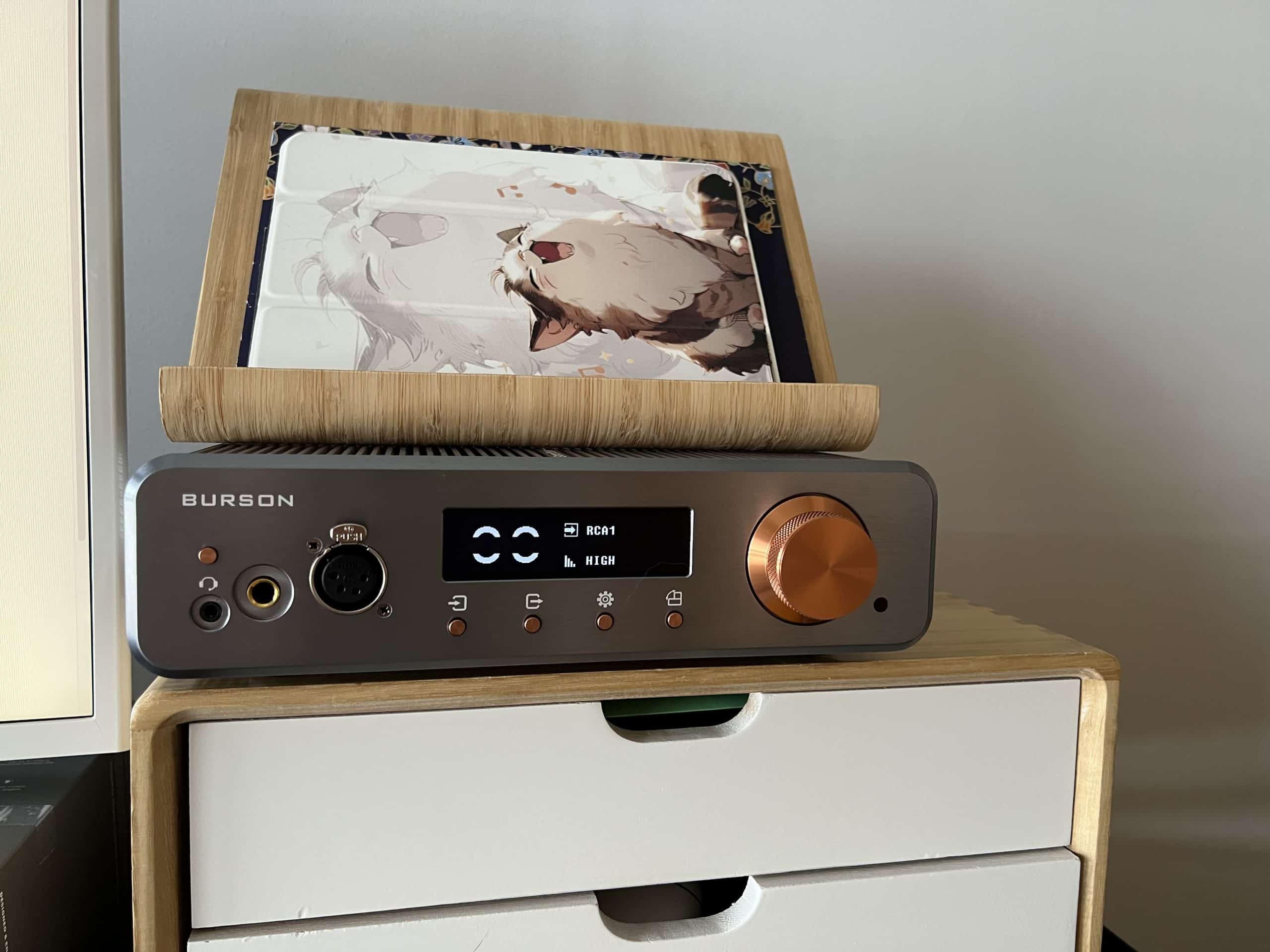
The Burson Soloist headphone amplifier stands out for its exceptional versatility, offering users the ability to fine-tune gain settings to perfectly match the impedance of various headphones. Whether you’re using the AKG K702, Sennheiser HD650, or 842, the Soloist brings out the distinct qualities of each headphone, elevating the listening experience to a new level of immersion and refinement.
With the AKG K702, the Soloist enhances the expansive soundstage, accentuating the crispness and clarity of the mids and highs, allowing for a truly open and airy sound. The Sennheiser HD650, on the other hand, benefits from the Soloist’s ability to bring out a rich, resonant string tone that makes orchestral and instrumental music feel more vivid and emotionally engaging. For the 842, the Soloist reveals the depth and warmth of the vocals, presenting them with an astonishing level of realism and presence that captures every subtle nuance.
In addition to its powerful amplification, the Soloist impresses with its precision and control. When enjoying electronic music, it effectively eliminates distracting background noise, enabling listeners to focus on the intricate details and layered structure of each track. The precise placement of individual elements within the music becomes strikingly clear, creating an immersive and almost dreamlike soundscape that pulls you deeper into the experience.
Ultimately, the Burson Soloist is much more than a mere amplifier—it’s a tool that ensures a highly refined and detailed listening experience. Whether you’re exploring the sonic subtleties of your favorite tracks or simply enjoying the beauty of music in its purest form, the Soloist guarantees a truly enjoyable and revealing session every time.
Matching notes: At 62 Ω and 105 dB/V, the AKG K702 is a low-impedance load, and a fairly demanding one: about 1.8 V (51 mW, 29 mA) for 110 dB SPL (calc.). Burson does not publish a 62 Ω rating for the Soloist GT4. Its 32 Ω and 100 Ω ratings (10 W XLR / 5 W SE; 8 W XLR / 4 W SE) fall either side of it. The Soloist GT4’s 0.5 Ω headphone output impedance is 1/124 of the load. [1] [2] [3]
Matching notes: At 300 Ω and 103 dB/V, the HD 650 is a high-impedance load that needs voltage more than current: about 2.2 V (17 mW, 7.5 mA) for 110 dB SPL (calc.). Burson rates the Soloist GT4 at 1.3 W (XLR) / 0.65 W (SE) into 300 Ω, which is about 19.7 V / 14.0 V RMS (calc.), roughly 19 dB / 16 dB more than that. The Soloist GT4’s 0.5 Ω headphone output impedance is 1/600 of the load. [4] [5] [2] [3]
Matching notes: At 300 Ω and 103 dB/V, the HD 820 is a high-impedance load that needs voltage more than current: about 2.2 V (17 mW, 7.5 mA) for 110 dB SPL (calc.). Burson rates the Soloist GT4 at 1.3 W (XLR) / 0.65 W (SE) into 300 Ω, which is about 19.7 V / 14.0 V RMS (calc.), roughly 19 dB / 16 dB more than that. The Soloist GT4’s 0.5 Ω headphone output impedance is 1/600 of the load. [6] [2] [3]
Specs from manufacturer data unless a source below says otherwise. “calc.” values are worked out from those figures (V = √(P × R); 110 dB SPL used as a loud reference level). Gear listed without specs is not in our spec library yet.