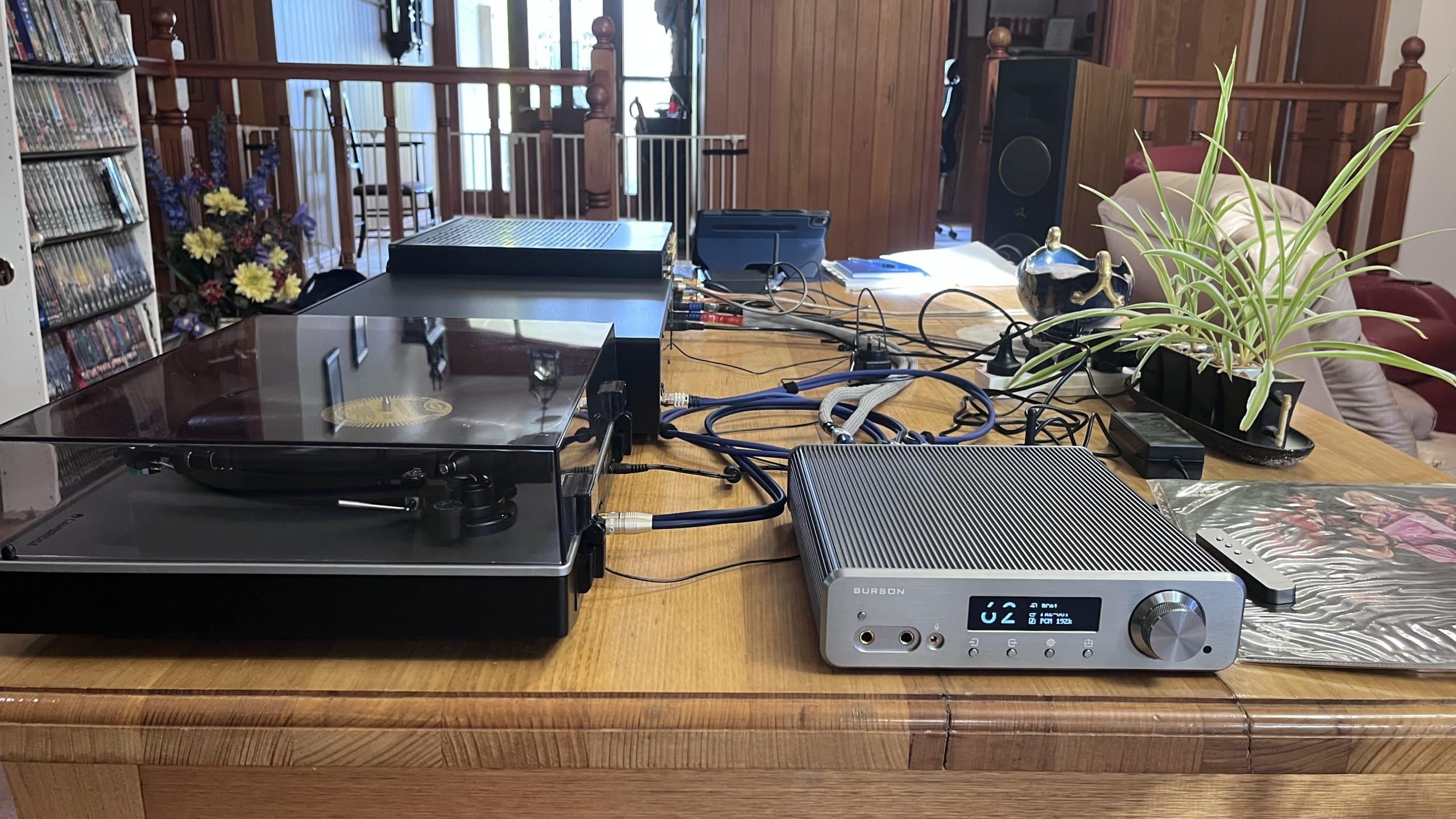
After spending countless hours researching various options, I ultimately chose the Burson Conductor 3R, and I couldn’t be more satisfied with my decision. With its special pricing, it felt like a great deal, but what really sold me was its impressive input/output functionality, which perfectly aligned with my needs. Although I’ve only had the chance to use it for an afternoon so far, I’m already incredibly impressed by the rich soundstage it brings out from my large floorstanding speakers. The audio quality is everything I was hoping for and more – clear, immersive, and dynamic. I’m excited to continue exploring all it has to offer!
The System
Listening with
MartinLogan Motion XT F200s
Burson
- Output power (headphone): 16 Ω 7.5 W · 32 Ω 5 W · 100 Ω 1.75 W · 150 Ω 1.16 W · 300 Ω 0.58 W
- Output impedance: 0.5 Ω (headphone); 1 Ω (pre out); 25 Ω (DAC out)
- Output voltage: RCA 2 V (DAC out)
- Gain: High / Medium / Low; dB not published
- Inputs: 2x RCA; USB (XMOS; PCM to 768 kHz/32-bit, native DSD512); Toslink; coaxial; Bluetooth 5.0 aptX HD; microphone
- Input impedance: 40 kΩ
- Input sensitivity: line level
- Outputs: RCA pre out; RCA DAC out; 2x 6.35 mm headphone
- DAC / chipset: 2x ESS ES9038Q2M
- Other: Model R180 (3R); SE only; THD <0.0015%; FR ±1 dB 0-58 kHz
[1] [2] [3]
Also in the system
Cambridge Audio Azur 651R
Yamaha A-S1000 · Integrated amp: stereo integrated amp (floating balanced power amp, MM/MC phono) · discontinued
- Frequency response: 5 Hz – 100 kHz (+0 / -3 dB); 20 Hz – 20 kHz (+0 / -0.3 dB)
- Power: 8 Ω: 90 (20 Hz-20 kHz, 0.02% THD) · 4 Ω: 140 (20 Hz-20 kHz, 0.02% THD)
- Inputs: line (RCA, XLR balanced); phono MM (2.5 mV / 47k) + MC (100 µV / 50 Ω); main in
- Input impedance: 47 kΩ (line)
- Input sensitivity: 0.15 V (CD / line); main in 1 V
- Outputs: speakers A/B; pre out; headphone
- Other: max power 115 W / 8 Ω, 190 W / 4 Ω (1 kHz, 10% THD); dynamic power 105 / 135 / 190 / 220 W (8/6/4/2 Ω); S/N 98 dB (CD); 22 kg
[4]
Yamaha CD-C603 CD Changer