
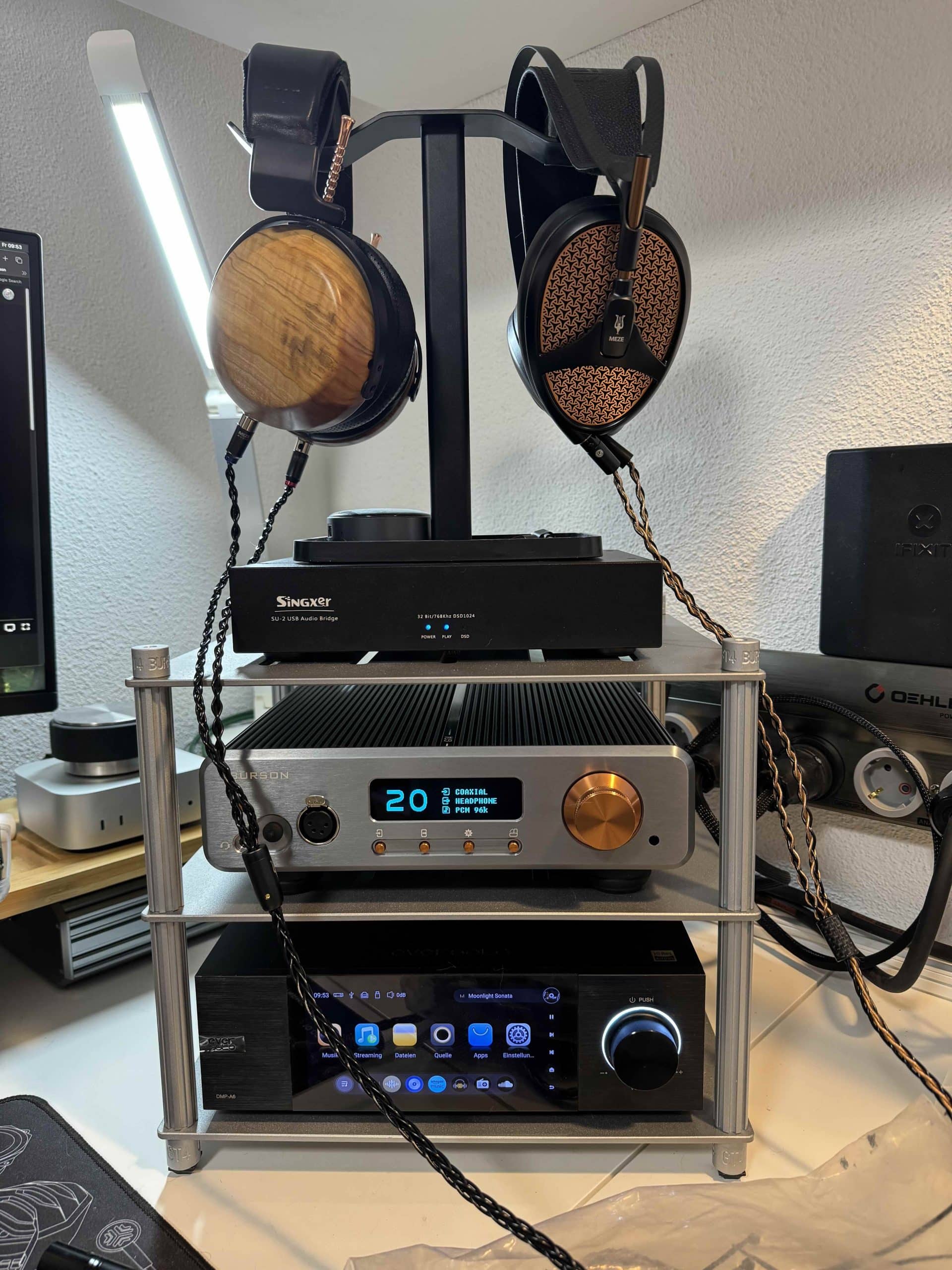
I’ve been a dedicated Burson fan for several years now, and during that time, I’ve had the chance to try some excellent gear—brands like Holo Audio, Hifiman Prelude, SPL, SMSL, and others. Yet, there’s always been something missing, that unique Burson sound that I’ve grown to love. I will say that both the Cyan 2 and the Prelude came close, offering a similar level of performance to the Conductor GT4 Max, but for my personal taste, Burson just fits better.
Now, the Conductor GT4… what can I say? It’s a true reference-quality machine. The sound it delivers is nothing short of extraordinary—powerful, controlled, and full of authority. The soundstage is impressively wide and deep, pulling you into the music in a way that feels natural and immersive. It has this incredible ability to reproduce the music exactly as it was intended, preserving the nuances of every recording. I can honestly say this is one of the best sound experiences I’ve had, and I couldn’t be happier with it.
The System
Listening with
- Impedance: 31.6 Ω
- Sensitivity: 100 dB SPL (1 mW / 1 kHz) ≈ 115.0 dB/V (calc.)
- Frequency response: 4 Hz – 110 kHz
- Plugs / cables supplied: 4-pin mini-XLR cable; 3 m OFC XLR cable
- Other: max SPL >130 dB; THD <0.1%; ~430 g; Rinaro driver
Matching notes: At 31.6 Ω and 100 dB/mW, the Meze Empyrean is a low-impedance load, and an efficient one: about 0.56 V (10 mW, 18 mA) for 110 dB SPL (calc.). Burson does not publish a 31.6 Ω rating for the Conductor GT4; its nearest published rating is 10 W XLR / 5 W SE into 32 Ω. The Conductor GT4’s 0.5 Ω headphone output impedance is 1/63 of the load. [1] [2] [3]
- Impedance: 300 Ω
- Sensitivity: ~96 dB/mW (approx., “~” as published)
- Frequency response: not published
- Plugs / cables supplied: not published (ZMF lists no connector type)
Burson
- Output power (XLR / SE): 32 Ω 10 W / 5 W · 100 Ω 5 W / 2.5 W · 150 Ω 3 W / 1.5 W · 300 Ω 2 W / 1 W
- Output impedance: 0.5 Ω (headphone); 1 Ω (pre out); 25 Ω (DAC out)
- Output voltage: RCA 2 V (DAC out) · XLR 4 V (DAC out); pre out max 12 V RMS
- Gain: 2 levels: High full power (XLR 10 W / SE 5 W), Low 10% (IEM); dB not published
- Inputs: 2x XLR; 2x RCA; USB (XMOS; PCM to 768 kHz/32-bit, native DSD512); Toslink; coaxial (24/192); Bluetooth 5.0 aptX HD; microphone
- Input impedance: 40 kΩ
- Input sensitivity: line level (24-bit/192 kHz ADC on analogue inputs)
- Outputs: headphone 6.35 mm / 4-pin XLR / 3.5 mm; XLR + RCA pre out; subwoofer pre out; XLR + RCA line (DAC) out
- DAC / chipset: 2x ESS9038 (one chip per channel; suffix not published)
- Other: THD <0.0015%; FR ±1 dB 0-58 kHz; versions: Standard (V6 Vivid, SP01, 24V5A) / Deluxe (V7 Vivid, SP02, Super Charger 5A) / Max (+Fusion Core 24V)
- Other: Fusion Core 24V: 24 V/15 A, 2.5 mm barrel (centre +); Fusion Core 32V: 32 V/15 A, 4-pin DC plug (Timekeeper 3X GT / Voyager / GT4); noise floor <1 µV; 100-240 V AC
Also in the system
- Frequency response: 20 Hz – 20 kHz (±0.15 dB)
- Output voltage: RCA 2.5 V · XLR 5 V
- Inputs: Wi-Fi / Ethernet; USB 3.0 x2; M.2 SSD; optical; coaxial; USB-C audio in; Bluetooth
- Outputs: XLR; RCA (pre out); optical; coaxial; HDMI (DSD multichannel); USB audio
- DAC / chipset: 2x ESS ES9038Q2M; XMOS XU316
- Other: THD+N <0.000092% XLR / <0.00011% RCA (A); SNR / DR >128 dB XLR, >124 dB RCA; 13 W
Specs from manufacturer data unless a source below says otherwise. “calc.” values are worked out from those figures (V = √(P × R); 110 dB SPL used as a loud reference level). Gear listed without specs is not in our spec library yet.
