
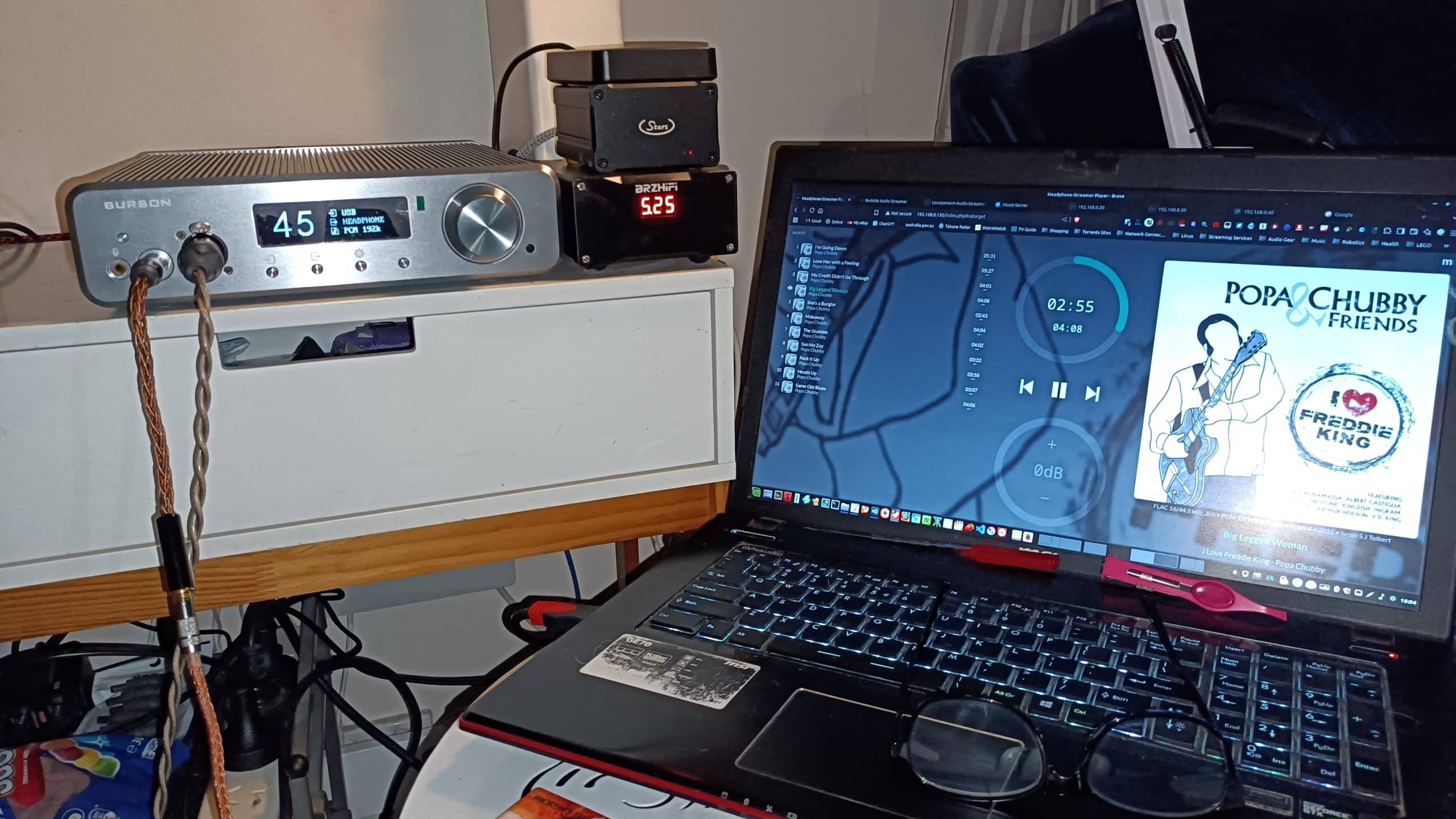
I’ve been the proud owner of the Soloist 3XP for the past three years, and it has served as a cornerstone of my audio setup with remarkable performance and reliability. After years of enjoyment with the Soloist, I recently decided to take the next step and invest in the Conductor 3XR.
The decision to upgrade wasn’t taken lightly, but based on my long-term experience with Burson’s quality and sonic signature, the Conductor 3XR felt like a natural progression. It’s an incredibly well-engineered piece of equipment that builds on everything I appreciated in the Soloist—offering even greater versatility, refinement, and power..
Matching notes: At 55 Ω and 104 dB/mW, the Focal Clear MG is a low-impedance load, and an efficient one: about 0.47 V (4 mW, 8.5 mA) for 110 dB SPL (calc.). Burson does not publish a 55 Ω rating for the Conductor 3X Reference. Its 32 Ω and 100 Ω ratings (5 W XLR / 2.5 W SE; 1.75 W XLR / 0.88 W SE) fall either side of it. The Conductor 3X Reference’s 0.5 Ω headphone output impedance is 1/110 of the load. [1] [2] [3] [4] [5]
Matching notes: At 32 Ω and 100 dB/mW, the T5 (3rd Generation) is a low-impedance load, and an efficient one: about 0.57 V (10 mW, 18 mA) for 110 dB SPL (calc.). Burson rates the Conductor 3X Reference at 5 W (XLR) / 2.5 W (SE) into 32 Ω, which is about 12.6 V / 8.9 V RMS (calc.), roughly 27 dB / 24 dB more than that. The Conductor 3X Reference’s 0.5 Ω headphone output impedance is 1/64 of the load. [7] [3] [4] [5]
Matching notes: At 250 Ω and 102 dB/mW, the DT 1990 PRO is a high-impedance load that needs voltage more than current: about 1.3 V (6.3 mW, 5 mA) for 110 dB SPL (calc.). Burson does not publish a 250 Ω rating for the Conductor 3X Reference. Its 150 Ω and 300 Ω ratings (1.16 W XLR / 0.58 W SE; 0.58 W XLR / 0.3 W SE) fall either side of it. The Conductor 3X Reference’s 0.5 Ω headphone output impedance is 1/500 of the load. [8] [3] [4] [5]
Specs from manufacturer data unless a source below says otherwise. “calc.” values are worked out from those figures (V = √(P × R); 110 dB SPL used as a loud reference level). Gear listed without specs is not in our spec library yet.