
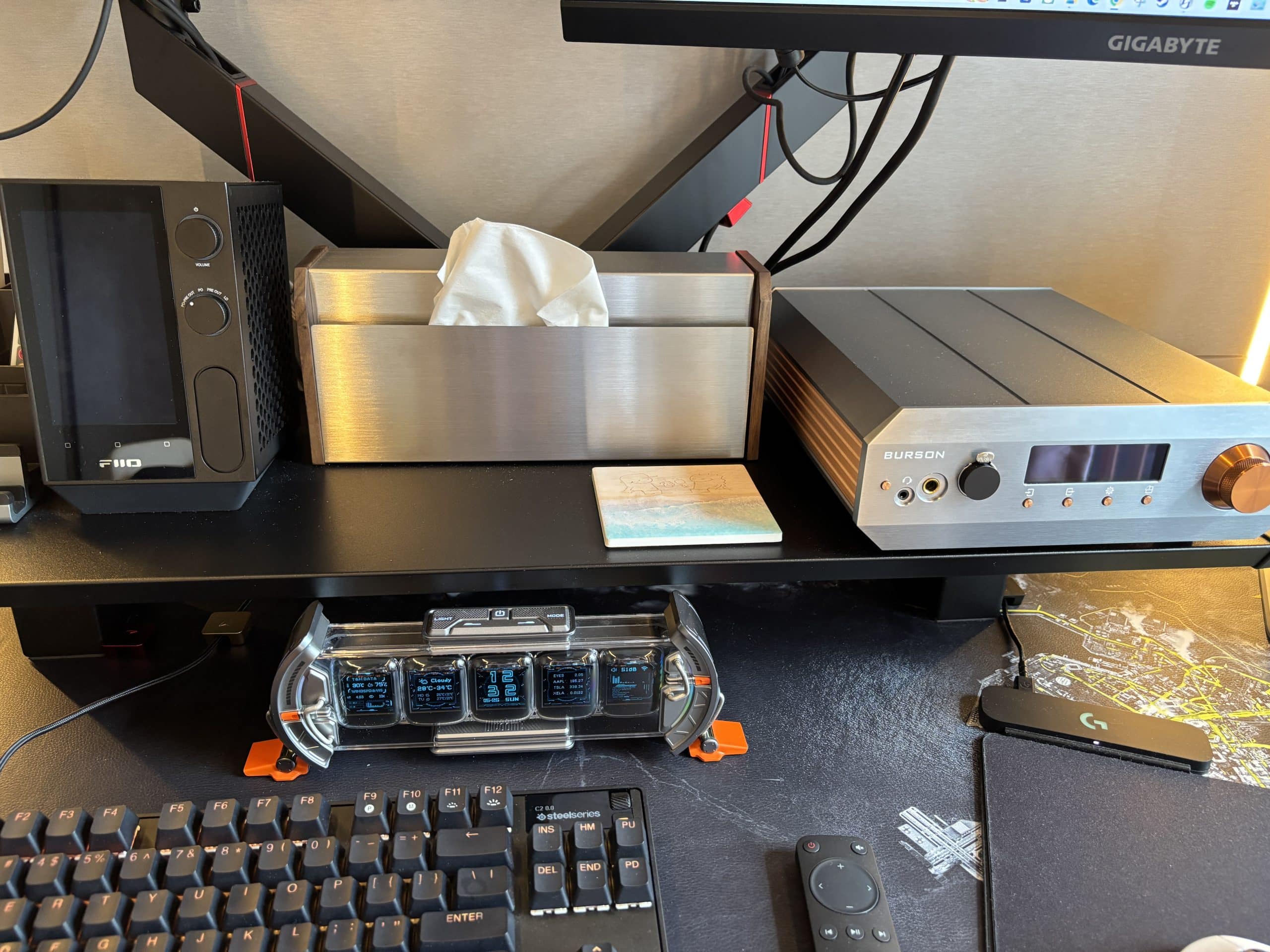
Justin’s Burson Soloist Voyager with Focal Utopia and HiFiMAN Arya Stealth

Published on

Post Info

The Burson Soloist Voyager is an extraordinary piece of audio engineering—an absolute revelation for any serious listener. From the very first listen, it delivered an audio experience that can only be described as heavenly. The sound is rich, immersive, and incredibly refined, with a level of clarity and detail that brings every note and nuance to life. It creates a stunningly lifelike soundstage, offering both power and finesse in equal measure. Whether you’re listening to complex orchestral arrangements or intimate acoustic tracks, the Soloist Voyager handles everything with remarkable precision and emotional depth. It’s more than just an amplifier—it’s a gateway to pure musical bliss.

The System

Listening with

Focal Utopia · Headphones: open-back, dynamic (40 mm beryllium M-dome), circumaural · discontinued
  • Impedance: 80 Ω
  • Sensitivity: 104 dB SPL / 1 mW @ 1 kHz ≈ 115.0 dB/V (calc.)
  • Frequency response: 5 Hz – 50 kHz
  • Plugs / cables supplied: 6.35 mm cable and 3.5 mm cable, 4-pin XLR cable; Lemo connectors at the cups
  • Other: THD <0.2% @ 1 kHz / 100 dB SPL

Matching notes: At 80 Ω and 104 dB/mW, the Focal Utopia is a low-impedance load, and an efficient one: about 0.56 V (4 mW, 7.1 mA) for 110 dB SPL (calc.). Burson does not publish a 80 Ω rating for the Soloist Voyager. Its 32 Ω and 100 Ω ratings (8 W XLR / 4 W SE; 3.8 W XLR / 1.9 W SE) fall either side of it. The Soloist Voyager’s 0.5 Ω headphone output impedance is 1/160 of the load. [1] [2] [3] [4]

HiFiMAN Arya Stealth · Headphones: open-back, planar magnetic, circumaural
  • Impedance: 32 Ω
  • Sensitivity: 94 dB (reference not stated by HiFiMAN)
  • Frequency response: 8 Hz – 65 kHz
  • Plugs / cables supplied: not published (HiFiMAN spec page lists no connector)
  • Other: weight 430 g

[5]

Burson

Burson Soloist Voyager · Headphone amplifier / preamp (Class-A)
  • Output power (XLR / SE): 16 Ω 10 W / 5 W · 32 Ω 8 W / 4 W · 100 Ω 3.8 W / 1.9 W · 150 Ω 1.3 W / 0.65 W · 300 Ω 0.64 W / 0.32 W
  • Output impedance: 0.5 Ω (headphone); 25 Ω (pre out)
  • Gain: 3 levels: High full power (XLR 10 W / SE 5 W), Medium 50%, Low 10% (IEM); dB not published
  • Inputs: 2x XLR; 2x RCA; mic bypass
  • Input impedance: 38 kΩ
  • Input sensitivity: RCA 2 V; XLR 4 V+ (line level)
  • Outputs: XLR + SE headphone; XLR + RCA pre out; RCA subwoofer out
  • Other: THD <0.0015%; FR ±1 dB 0-48 kHz; Standard/Deluxe: 24V5A PSU or Super Charger 5A, V6 Vivid or V7 Vivid Pro; SP02 installed

[3] [4]

Also in the system

AudioQuest Yukon XLR
Crystal Ep-G
FiiO R7
QED Signature RCA

Specs from manufacturer data unless a source below says otherwise. “calc.” values are worked out from those figures (V = √(P × R); 110 dB SPL used as a loud reference level). Gear listed without specs is not in our spec library yet.

  1. Focal Utopia: PDF (dam.focal-naim.com)
  2. Focal Utopia: focalnaimaudio.com
  3. Burson Soloist Voyager product page
  4. Burson Soloist Voyager User Manual V1.2 (Burson downloads)
  5. HiFiMAN Arya Stealth: hifiman.com