
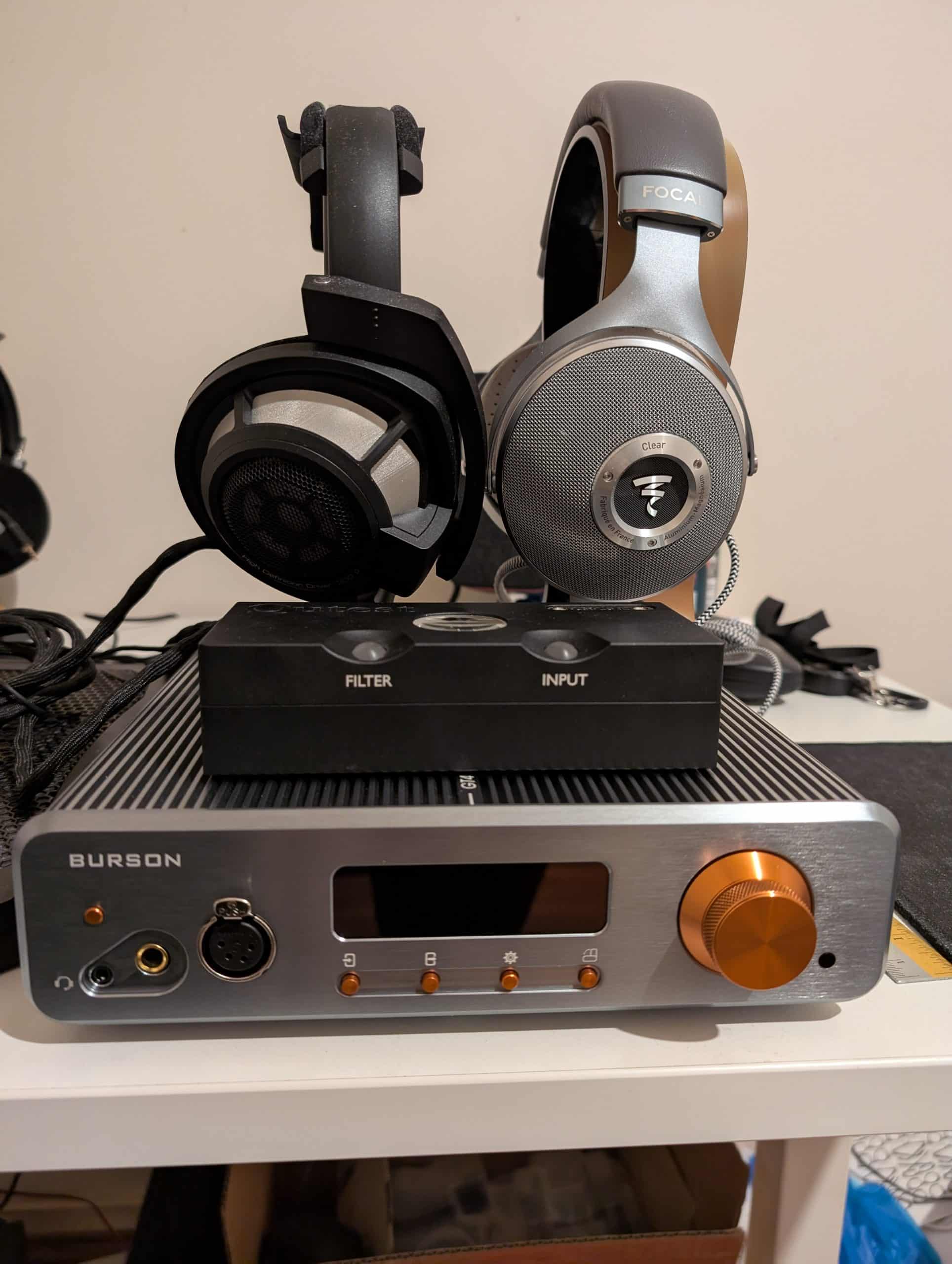
Huge thanks to Nelson for setting me up with the incredible Soloist GT4 Deluxe package—what an outstanding upgrade. My journey with Burson began with the Playmate 2. While the DAC section didn’t quite suit my preferences, I was immediately drawn to Burson’s unique and engaging sound signature.
After adding the Chord Qutest to my setup, I knew I wanted to pair it with a Burson amplifier, and I was fortunate to receive a fantastic deal from the team. The combination of the Silent Power and Supercharger is especially impressive—it significantly reduces background noise, resulting in a cleaner, more refined listening experience.
The V7 op-amps truly elevate the performance, delivering greater detail, depth, and soundstage. On top of that, the build quality is exceptional—solid, sleek, and clearly built to last. Overall, it’s been a thoroughly rewarding upgrade and a setup I’m genuinely excited about.
Matching notes: At 300 Ω and 102 dB/V, the HD 800 S needs voltage more than current: about 2.5 V (21 mW, 8 mA) for 110 dB SPL. Burson rates the Soloist GT4 at 1.3 W (XLR) / 0.65 W (SE) into 300 Ω, which is about 19.7 V / 14.0 V RMS (calc.), roughly 18 dB / 15 dB more than that. The GT4’s 0.5 Ω output impedance is 1/600 of the load. The supplied plugs are 6.35 mm and 4.4 mm; the GT4’s balanced output is 4-pin XLR. [4] [1]
Matching notes: At 55 Ω and 104 dB/mW, the Clear is a low-impedance, efficient load: about 4 mW (0.47 V, 8.5 mA) for 110 dB SPL. Burson does not publish a 55 Ω rating for the GT4. Its 32 Ω and 100 Ω ratings (10 W / 8 W XLR, 5 W / 4 W SE) fall either side of it. The GT4’s 0.5 Ω output impedance is 1/110 of the load. The supplied 4-pin XLR cable fits the GT4’s balanced headphone output. [5] [1]
Matching notes: Burson lists the GT4’s RCA input as 2 V line level (38 kΩ). The Qutest’s 2 V setting matches that; its 3 V setting is 3.5 dB higher. [6] [7] [2]
Specs from manufacturer data. “calc.” values are worked out from those figures (V = √(P × R); 110 dB SPL used as a loud reference level).