
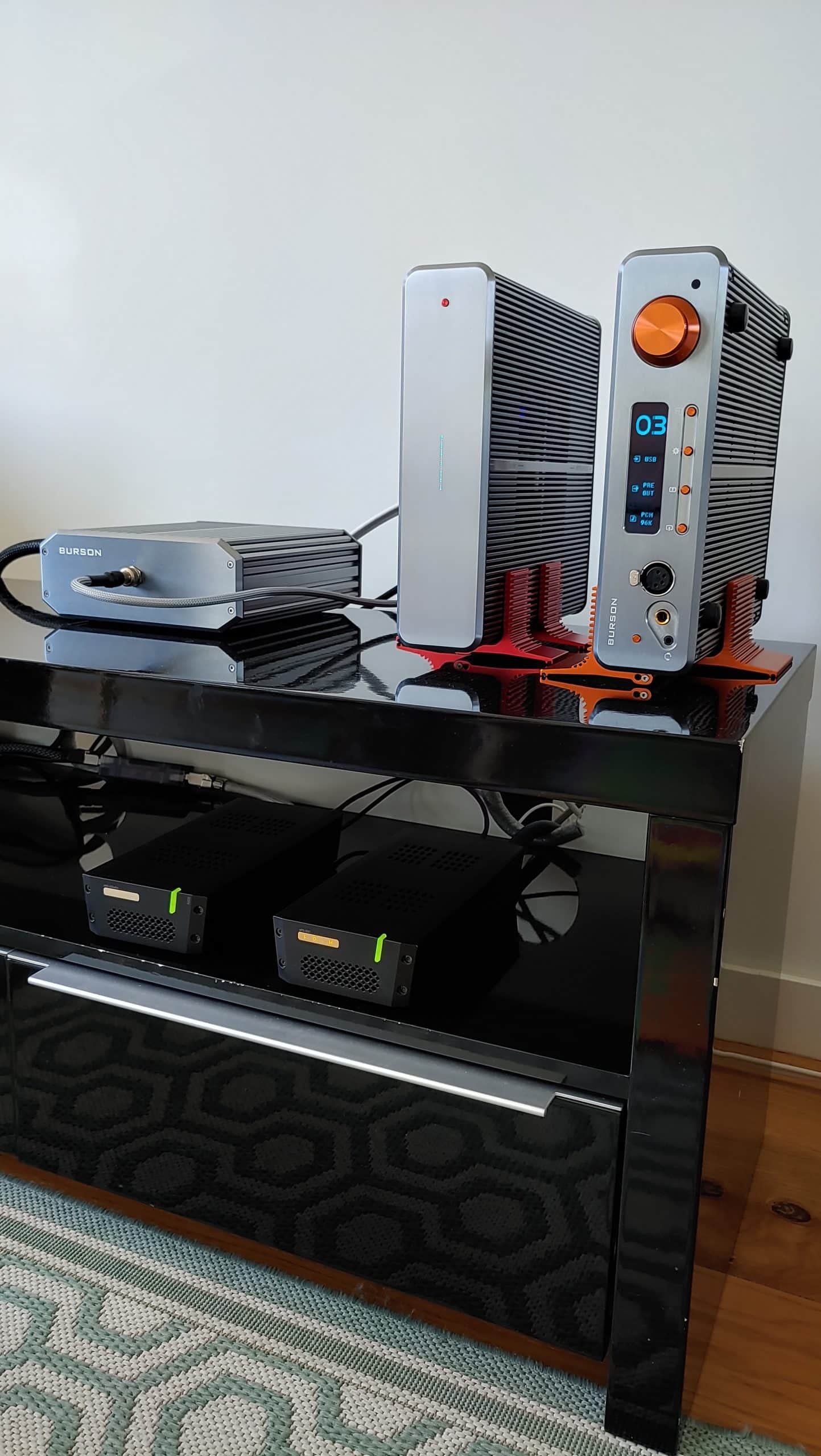
What I’ve always appreciated about Burson equipment is the remarkable sense of engagement and dynamic presence it brings to music. There’s a palpable “live” quality in the way it reproduces sound—vivid, immediate, and emotionally involving. With the addition of the Fusion Core, this experience has evolved even further. It introduces an impressive sense of naturalness and effortlessness to the listening experience. The music flows with such ease and organic clarity that I find myself completely immersed, yet without any trace of listening fatigue. It strikes a beautiful balance between detail and warmth, energy and refinement, making long sessions not only possible but truly enjoyable.
The System
Listening with
- Impedance: 6 Ω (minimum 3.5 Ω)
- Sensitivity: 87.5 dB (2.83 V / 1 m, free field)
- Frequency response: 42 Hz – 20 kHz (±3 dB)
- Connectors: five-way binding posts
- Recommended amplifier power: 20 – 200 W
- Other: in-room sensitivity 90.5 dB/2.83 V/m; -10 dB at 32 Hz; crossovers 380 Hz / 2,850 Hz; power handling 200 W (800 W peak); 3-position mid/HF switch; 20 kg
Matching notes: The Model 5 is rated at 87.5 dB (2.83 V / 1 m) into 6 Ω nominal (3.5 Ω minimum). Burson rates the Timekeeper 3X GT at 110 W into 8 Ω and 180 W into 4 Ω. At that rating the speaker would reach about 108 dB SPL at 1 m (calc., one speaker, before room gain). KLH recommends 20 – 200 W amplifiers. [1] [2] [3] [4]
- Impedance: 35 Ω
- Sensitivity: 96 dB (reference not stated by HiFiMAN)
- Frequency response: 8 Hz – 65 kHz
- Plugs / cables supplied: not published (HiFiMAN spec page lists no connector)
- Other: weight 440 g
Burson
- Output power (XLR / SE): 32 Ω 10 W / 5 W · 100 Ω 5 W / 2.5 W · 150 Ω 3 W / 1.5 W · 300 Ω 2 W / 1 W
- Output impedance: 0.5 Ω (headphone); 1 Ω (pre out); 25 Ω (DAC out)
- Output voltage: RCA 2 V (DAC out) · XLR 4 V (DAC out); pre out max 12 V RMS
- Gain: 2 levels: High full power (XLR 10 W / SE 5 W), Low 10% (IEM); dB not published
- Inputs: 2x XLR; 2x RCA; USB (XMOS; PCM to 768 kHz/32-bit, native DSD512); Toslink; coaxial (24/192); Bluetooth 5.0 aptX HD; microphone
- Input impedance: 40 kΩ
- Input sensitivity: line level (24-bit/192 kHz ADC on analogue inputs)
- Outputs: headphone 6.35 mm / 4-pin XLR / 3.5 mm; XLR + RCA pre out; subwoofer pre out; XLR + RCA line (DAC) out
- DAC / chipset: 2x ESS9038 (one chip per channel; suffix not published)
- Other: THD <0.0015%; FR ±1 dB 0-58 kHz; versions: Standard (V6 Vivid, SP01, 24V5A) / Deluxe (V7 Vivid, SP02, Super Charger 5A) / Max (+Fusion Core 24V)
- Power: 8 Ω: 110 (high gain); 30 (low gain) · 4 Ω: 180 (high gain); 55 (low gain)
- Output impedance: <0.015 Ω (20 Hz-20 kHz)
- Gain: 29 dB; 2 gain levels (high / low)
- Inputs: 1x RCA; 1x XLR
- Input impedance: 100 kΩ (SE); 200 kΩ (balanced)
- Outputs: speaker binding posts
- Other: Model R300 (“GT3”); max power 210 W; THD <0.03% @ 1 kHz; S/N 108 dB; Super Charger 32V/6.5A
- Output impedance: not published
- Other: Supply ±4 V (8 VDC) to ±16 V (30 VDC); 18 mA single / 35 mA dual
Also in the system
Specs from manufacturer data unless a source below says otherwise. “calc.” values are worked out from those figures (V = √(P × R); 110 dB SPL used as a loud reference level). Gear listed without specs is not in our spec library yet.
- KLH Model 5: stereophile.com (magazine reproduction of manufacturer specs)
- KLH Model 5: klhaudio.com (magazine reproduction of manufacturer specs)
- Burson Timekeeper 3X GT product page
- Burson Timekeeper 3X GT User Manual V1.0 (Burson downloads)
- HiFiMAN HE1000se: hifiman.com
- Burson Conductor GT4 product page
- Burson V7 Vivid Opamp product page
